01BUSINESS OPPORTUNITY
Business Overview
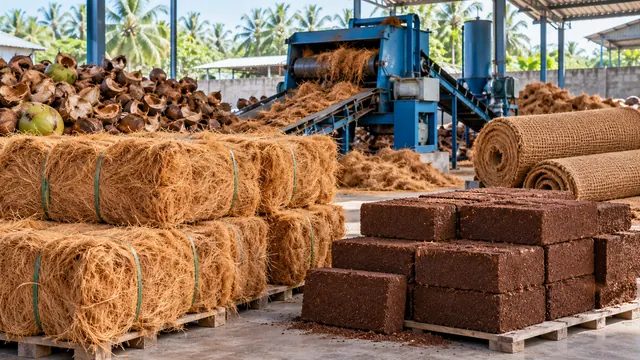
Coconut husks are abundant agricultural residues across NTT coastal communities that are predominantly discarded or burned open-air. This mechanical decortication project separates husks into two high-value commercial fractions: long, high-tensile coir fiber (used in automotive seats, mattress padding, erosion control geotextiles, and marine cordage) and organic coir pith (cocopeat). With low electrical conductivity (EC < 0.5 mS/cm) achieved through washing and maturation, cocopeat is compressed into 5 kg blocks and exported globally as a superior peat-moss substitute for greenhouse hydroponics. KIB provides spacious open drying pads, industrial water, and discounted backhaul container access to Surabaya and international shipping routes.
Products & Business Formats
- Raw Baled Coconut Coir Fiber (Golden Brown Fiber)
- Mechanically extracted, cleaned, and hydraulically baled long coir fibers (100–120 kg bales) for automotive seat padding, mattresses, and geotextiles.
- Washed Low-EC Compressed Cocopeat Blocks (5 kg Blocks)
- Washed, low-salinity (EC < 0.5 mS/cm) compressed cocopeat blocks (5:1 expansion ratio) for commercial greenhouse hydroponics and soil conditioning.
- Erosion-Control Coir Geotextile Mats & Biodegradable Logs
- Woven coconut coir fiber mesh nets and packed bio-logs for civil engineering slope stabilization, riverbank erosion control, and mine reclamation.
- Cocopeat Grow Bags & Hydroponic Planting Slabs
- UV-stabilized polyethylene grow bags packed with pre-measured cocopeat/coir-chip blends for commercial tomato and berry hydroponic cultivation.
Business model
A zero-waste business model: one mechanical coconut-husk separation process yields cocofiber (sold in baled tonnes to industrial/export markets) and cocopeat (pressed into growing-medium blocks for domestic and overseas horticultural markets).
Development stages
- Stage 1 — Use ready-to-lease buildings at KIB to install husk-shredding and defibering machines, rotary screens separating fibre and pith, and baling presses.
- Stage 2 — Add cocopeat washing tanks, a measured drying area, and a hydraulic block press to produce export-standard cocopeat blocks.
- Stage 3 — Develop coir-rope spinning and geotextile-net weaving (cocomesh) lines on KIB HPL land plots to serve construction and land-rehabilitation projects.
02BUSINESS OPPORTUNITY
Market & Potential Buyers
Global demand for natural, biodegradable growing media has created explosive growth for washed cocopeat, which is rapidly replacing environmentally damaging peat moss across Europe, North America, and Australia. Simultaneously, automotive and civil engineering markets demand natural coir fiber. NTT’s massive coconut resources provide an untapped feedstock reservoir.
Market Demand & Potential Buyers
- Horticultural greenhouse growers and nursery substrate distributors in Australia, South Korea, Japan, and Europe
- Automotive seating and mattress manufacturers in Java and Southeast Asia requiring natural fiber pads
- Mining reclamation and civil engineering infrastructure contractors purchasing erosion control geotextiles
- Local commercial horticulture, dragon fruit, and vegetable farmers in Timor and Flores
Market Evidence & Context
Millions of Coconut Husks Discarded Annually across NTT
Coastal farming communities in Kupang, Rote, Flores, and Sumba generate vast volumes of coconut husks that are currently treated as agricultural waste or burned open-air. Bolok Industrial Park Profile
High Solar Irradiance for Low-Cost Open-Air Maturation & Drying
Kupang’s prolonged dry season and high solar radiation provide ideal conditions for natural solar drying of washed cocopeat, saving massive thermal fuel costs. Bolok Industrial Park Profile
Existing coir processing in Indonesia is heavily concentrated in North Sulawesi, Lampung, and Central Java, where raw husk procurement is highly competitive. An export-focused coir and cocopeat plant at KIB secures raw husks at rock-bottom local costs, utilizes Kupang’s sunny climate for natural drying, and ships directly out of Tenau Port.
03BUSINESS OPPORTUNITY
Raw Materials & Supply
Raw coconut husks are collected from copra-producing villages and commercial coconut plantations across Kupang Regency, Rote Ndao, Semau, and Flores.
Raw material sources and requirements| Materials & Requirements | Procurement Source | Quality & Key Specifications |
|---|
| Raw Coconut Husks (Fresh or Air-Dried) | Copra farmers and coconut gathering centers across Timor, Rote, and Flores. | Whole or halved husks, free of stones, plastic debris, and excessive soil. |
|---|
| Fresh Wash Water for Cocopeat Desalination | KIB estate industrial water reservoir and rainwater harvesting ponds. | Low electrical conductivity water to wash out natural potassium and sodium salts from raw coir pith. |
|---|
| Industrial Power & Baling Wire | KIB electrical grid and regional hardware suppliers. | Stable 380V power for heavy decorticator drums and galvanized baling wire. |
|---|
Seasonality & Supply Continuity
Husk collection is continuous year-round. Washing and open-air concrete yard drying operate at peak efficiency during Timor’s dry season (April–November).
Collection & shipping
Raw husks arrive via flatbed trucks from inland villages or by coastal wooden boat at Bolok Harbor, transferring directly into KIB storage yards.
Procurement & handling costs
Raw husk acquisition and transport account for 45%–55% of production cost. Establishing village collection centers with manual husk splitters maximizes truckload density.
04BUSINESS OPPORTUNITY
Why Consider KIB
KIB provides the large yard footprint required for husk storage and washing, coupled with immediate access to Tenau Port for containerized export.
- Abundant Land Footprint for Washing Concrete Drying Pads
- Cocopeat washing and solar drying demand extensive outdoor concrete slabs, which KIB provides under long-term HPL lease agreements at attractive rates. Bolok Industrial Park Profile
- Estate AMDAL Envelope for Water Washing Management
- KIB’s master environmental framework accommodates large-scale washing ponds and settling basins for recycling tannin-rich washwater. Bolok Industrial Park Profile
05BUSINESS OPPORTUNITY
Business Development Requirements
Investors can deploy an integrated mechanical decortication and hydraulic baling line, complemented by concrete washing ponds and automated 5 kg block hydraulic presses.
Business process
- Raw husk intake, inspection, and feeding into high-speed rotating beater decorticator drums
- Separation of long coir fiber from fine coir pith (cocopeat) using rotary trommel screens
- Fiber cleaning in secondary beaters, air drying, and compression into 100 kg export bales using hydraulic presses
- Transferring raw cocopeat to concrete washing basins for multi-stage fresh water washing to reduce salinity (EC < 0.5 mS/cm)
- Mechanical dewatering through continuous screw presses and solar drying on elevated concrete platforms
- Final sieving, moisture verification (<15%), and high-pressure compression into 5 kg blocks (5:1 expansion ratio) with automated pallet shrink-wrapping
Initial Capacity & Production Scale
- High-Capacity Mechanical Husk Decorticator
- Heavy-duty steel drum decorticator with hardened manganese steel beaters driven by a 55–75 kW electric motor.
- Automated 5 kg Cocopeat Hydraulic Block Press
- High-pressure hydraulic press capable of exerting 150–200 tonnes pressure to compress loose cocopeat into uniform 30x30x12 cm blocks.
- Washing Ponds & Closed-Loop Water Recycling System
- Concrete leaching basins with drainage sumps and sand filters to wash out tannins and salts while recycling process water.
- Industrial Heavy-Duty Fiber Baling Press
- Vertical double-box hydraulic baler to compact raw coir fiber into high-density export bales strapped with galvanized wire.
Dedicated Production Facilities (Investor Scope)
Husk decorticator, rotary trommel screens, fiber baling press, cocopeat washing basins, solar concrete drying floor, 5 kg block hydraulic presses, and finished export container loading docks.
Monetizing discarded coconut husks into high-margin washed cocopeat blocks and baled fiber captures international export premiums while taking advantage of cheap backload container freight out of Kupang.
06BUSINESS OPPORTUNITY
Estate Facilities Available at KIB
Bolok Industrial Park (KIB) prepares Phase I with a total area of 191 hectares under clean & clear Right of Management (HPL) land titles with flexible plot sizing, alongside ready-to-lease standard industrial warehouses. The facilities below represent the core estate infrastructure provided by KIB, while tenant-specific production machinery and specialized civil/utility works remain the investor's scope.
- Phase I (Total 191 Ha HPL) & Flexible Plot Sizing
- Clean & clear HPL land title spanning 191 hectares in Phase I, with plot boundaries customized to factory or logistics yard requirements.
- Standard Ready-to-Lease Warehouses
- Basic turn-key warehouse structures ready for storage or lightweight modular machine assembly; specialized retrofits installed by tenant.
- Paved Heavy-Duty Main Estate Roads
- Dedicated estate road network engineered for heavy truck and container maneuvers connecting to Bolok Port (3.6 km) and Tenau Port (7.9 km).
- Clean Water Grid & Distribution Reservoirs
- Industrial water distribution network backed by on-site storage reservoirs; advanced water purification (e.g., RO/UV) configured per plant.
- Estate Electrical Power Grid
- Medium-voltage power grid connections for operational loads; dedicated transformers or backup generator sets installed per plant load profile.
- Fiber Optic Telecom & Estate Street Lighting
- High-speed optical fiber connectivity, environmental street illumination, and planned green buffer zones across the estate.
Site Suitability & Building Delivery Boundaries
Large industrial plots (1–3 hectares) in KIB Zone I with extensive open-air space for washing basins, drying aprons, and raw husk stockpiles.
Prospective investors are advised to consult with the KIB management team regarding exact plot sizes, standard warehouse technical specifications, electrical power capacity, and water flow rates prior to concluding detailed feasibility studies.
The management team of PT Kawasan Industri Bolok (Perseroda) assists local, national, and international investors (Timor-Leste, Australia, China, etc.) from initial site inspection through to leasing and operational licensing.
Estate Facilities Profile ↗BUSINESS OPPORTUNITY
Risks & Considerations
Primary operational risks include high electrical conductivity (EC) failing export horticultural specifications, seasonal rain slowing solar drying, and husk collection logistics.
- Excessive salinity (EC > 0.8 mS/cm) in cocopeat leading to export container rejection
- Implement rigorous multi-stage fresh water washing with daily digital EC/pH monitoring before releasing batches to compression.
- Protracted monsoon rains (December–March) halting outdoor solar drying
- Construct covered polycarbonate solar greenhouse drying tunnels and install secondary biomass-fired rotary flash dryers.
- Low husk volume per truckload inflating raw material transport costs
- Equip rural collection hubs with mechanical hydraulic husk crushers to double the packing density of trucks before transit to KIB.
08BUSINESS OPPORTUNITY
Studies & References
Data sources include International Coconut Community (ICC) technical standards, Dutch greenhouse substrate specifications, and KIB site environmental frameworks.
Data & Publications· 2025
Outlook of Coconut Plantation Commodities 2025
Ministry of Agriculture of the Republic of Indonesia· Indonesia
Read summary
National statistical review of coconut acreage, replanting programs, copra yields, and derivative export flows, highlighting Eastern Indonesia and NTT as primary producers of organic, low-cost raw nuts.
Technology Application· 2023
Coconut Coir Processing with Shredder Machines in Candimulyo Village
Sewagati · Institut Teknologi Sepuluh Nopember (ITS)· Dolopo, Madiun
Authors: Fahmi Astuti and team
Read summary
Implementation of mechanical coir decortication separating long fiber (cocofiber) from peat dust (cocopeat), providing a scalable machinery blueprint for converting Timor island raw husks into export-grade horticultural blocks and rubberized coir sheets at KIB.
Accessed 2026-10-19
Research· 2026
SWOT Analysis of Sodamolek Virgin Coconut Oil (VCO) in West Amarasi, Kupang Regency
Jurnal Agribisnis Kepulauan · Universitas Nusa Cendana· West Amarasi, Kupang Regency
Authors: Adolfina Kudji Lede, Imanuel Talan, Surya Setyawan
Read summary
Field analysis of community-based VCO production in West Amarasi, evaluating cold-press extraction and local nut supply, identifying mechanical centrifugation and hygienic packaging at KIB as key steps for commercial scaling.
Regional Data· 2024
WebGIS 2023 Agricultural Census (ST2023) of East Nusa Tenggara Province
BPS - Statistics Indonesia· East Nusa Tenggara
Read summary
Geospatial census mapping across NTT documenting 674,336 food crop production units (predominantly corn), 33,891 fishery business units, and 149,000 hectares of coconut estates, quantifying the hinterland supply base for KIB.
Accessed 2026-10-19
Industrial Park & Logistics· 2026
Road Distances from KIB Bolok to Key Port, City, and Airport Hubs
OpenStreetMap · OSRM Routing· Bolok, Tenau, Kupang City & El Tari Airport
Read summary
Calculated highway route distances from KIB Bolok: 3.6 km to Bolok ASDP Ferry Terminal, 7.9 km to Tenau Container Port, 14.5 km to central Kupang commercial district, and 25.0 km to El Tari International Airport.
Accessed 2026-10-19
Industrial Park & Logistics
Kupang Container Terminal Service Profile
PT Pelindo Terminal Petikemas· Tenau, Kupang
Read summary
Kupang Container Terminal at Tenau Port (7.9 km from KIB) handles dry and refrigerated container cargo (reefer plugs) with scheduled feeder connections to Surabaya, Makassar, and national shipping routes for raw materials and outbound finished products.
Accessed 2026-10-19
Industrial Park & Logistics
Bolok Industrial Park Profile
PT Kawasan Industri Bolok (Perseroda)· Bolok, West Kupang
Read summary
Official profile of the Bolok Industrial Park (Phase I covers 191 hectares with clean & clear HPL land title, flexible lease plots, ready-to-use standard factory/warehouse units, paved primary roads, clean water reservoir system, three-phase industrial power, and fiber-optic connectivity).
Accessed 2026-10-19
BUSINESS OPPORTUNITY
Next Steps
Interested in developing this business at KIB?
Submit required land footprint (hectares) and water volume requirements to KIB management to reserve suitable development parcels with washing drainage access.
Discuss your business plan ↗ Complete your business supply chain
Export-Grade Coconut Shell Charcoal Briquette Manufacturing
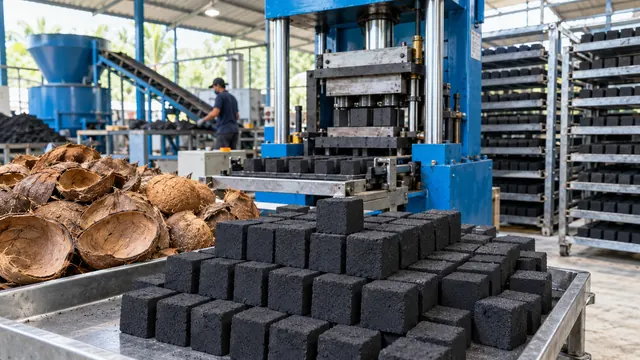
Manufacture premium hexagonal and cube charcoal briquettes from Timor and Flores coconut shells, serving domestic grill markets and premium export shisha channels in the Middle East and Europe.
View details →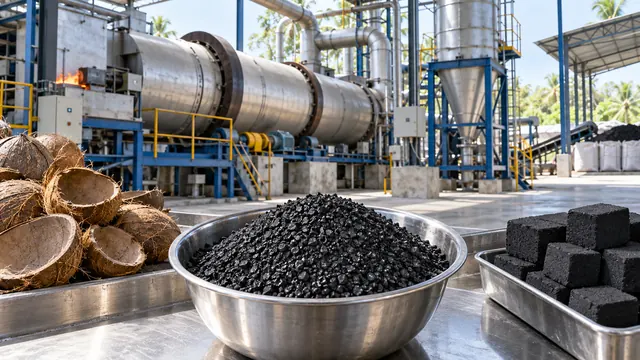
Industrial Steam-Activated Carbon from Hardwood & Coconut Shells
High-temperature steam activation plant producing premium granular and powdered activated carbon (iodine number 900–1,100 mg/g) for water filtration, gold mining, and air purification.
View details →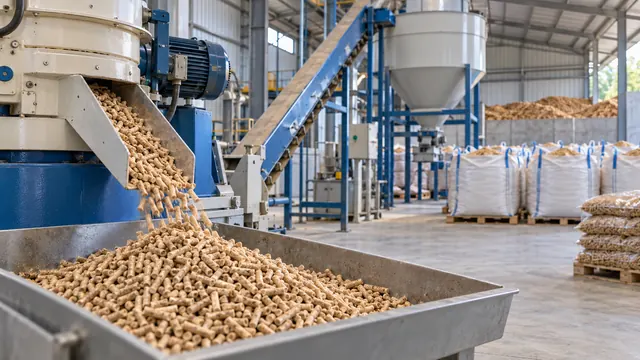
Biomass Wood Pellet & Agricultural Residue Fuel Processing
Produce high-density biomass wood pellets from fast-growing energy timber (Gamal, Calliandra) and dry crop residues to supply co-firing power plants and regional industrial boilers.
View details →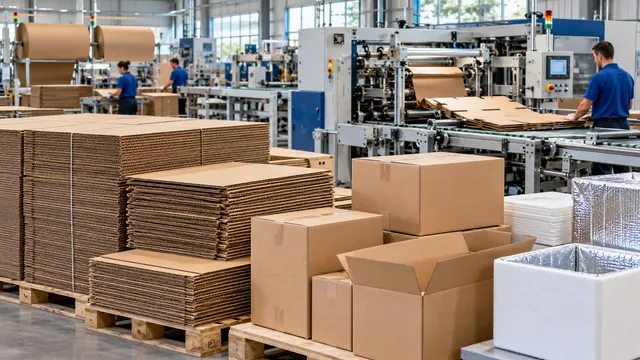
Export Packaging & Corrugated Carton Box Manufacturing
Establish a corrugated carton box, inner partition, and export-grade packaging manufacturing plant inside KIB to supply seafood processors, food manufacturers, and cross-border trade.
View details →