01BUSINESS OPPORTUNITY
Business Overview
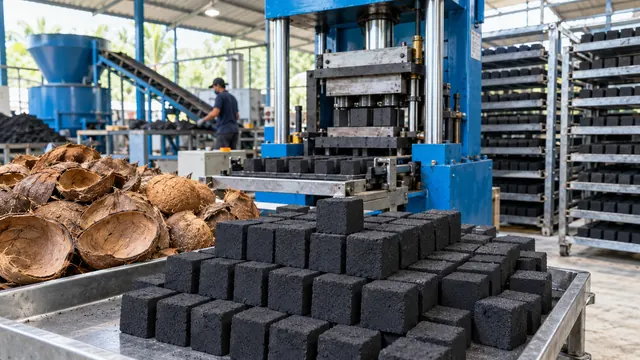
NTT possesses extensive coastal coconut groves across Timor, Flores, and Sumba, generating thousands of tonnes of dense, thick-walled coconut shells as agricultural processing residues. This enterprise carbonizes coconut shells into high-fixed-carbon granular charcoal, followed by ultra-fine pulverization, food-grade tapioca starch binding, high-pressure extrusion, and controlled kiln drying. The resulting briquettes deliver high calorific output (>7,200 kcal/kg), prolonged burn times (>2.5 hours), low ash content (<2.5%), and white ash coloration required by international shisha and gourmet barbecue buyers. KIB offers abundant open yard storage, industrial power for heavy extruders, and rapid container stuffing for export via Tenau Port.
Products & Business Formats
- Premium Shisha Coconut Charcoal Briquettes (Cube Format)
- High-density 25 mm & 26 mm cubic briquettes with low ash (<2.2%), pure white ash color, zero smoke, and burn times exceeding 2.5 hours for export.
- Barbecue (BBQ) Hexagonal Briquettes (Pillow & Hexa)
- Heavy hexagonal briquettes with center aeration holes, delivering high, stable heat (>7,000 kcal/kg) for commercial grilling and culinary roasting.
- Industrial Metallurgical Fuel & Smelter Briquettes
- High-fixed-carbon (>78%) industrial briquettes utilized as high-grade carbon reductants in regional non-ferrous metal smelting and foundry operations.
- Granular Screened Charcoal for Activated Carbon Feedstock
- Uniform 4x8 and 8x30 mesh carbonized coconut shell granules supplied to industrial activated carbon activation kilns.
Business model
The most efficient business model is a hub-and-spoke arrangement: shell carbonisation takes place at smallholder coconut-growing centres to reduce transport weight, while fine grinding, binder mixing, high-pressure moulding, oven drying, and buyer-branded box packaging (private label) are centralised at KIB.
Development stages
- Stage 1 — Use ready-to-lease buildings at KIB to install charcoal crushers, mesh screens, binder mixers, briquette presses, and drying-oven chambers.
- Stage 2 — Build a partnership network of clean carbonisation (pyrolysis) units with coconut collectors in Kupang Regency (such as Amarasi Barat), Rote Island, and the Timor region.
- Stage 3 — Develop a multi-brand export-packaging line and expand oven capacity and container-quarantine warehousing on KIB HPL land plots.
02BUSINESS OPPORTUNITY
Market & Potential Buyers
Indonesia is the undisputed global leader in premium coconut shell charcoal briquettes, exporting over $300 million annually to the Middle East, Europe, and North America. NTT holds substantial, unexploited coconut acreage; establishing processing in KIB eliminates intermediate shipping to Java and directly targets export markets.
Market Demand & Potential Buyers
- Premium shisha and hookah brand distributors in the Middle East (UAE, Saudi Arabia, Turkey) and Europe (Germany, France, UK)
- Specialty barbecue and gourmet restaurant wholesalers in Australia, Singapore, and South Korea
- Industrial smelting and foundry operators across Eastern Indonesia requiring high-purity carbon reductants
- Local culinary enterprises, traditional smoked meat (Sei) producers, and urban restaurants in Kupang
Market Evidence & Context
Dense, Thick Coconut Shell Quality in Semi-Arid Timor & Flores
NTT’s dry climate and long sunshine hours yield coconut shells with significantly thicker walls and lower natural moisture than wet-zone Java palms, producing superior carbon density. Bolok Industrial Park Profile
Most commercial briquette manufacturing is concentrated in Central and East Java, where raw coconut shell charcoal prices are escalating due to supply competition. A manufacturing plant at KIB secures raw charcoal directly from NTT and Maluku at lower procurement costs, utilizing competitive regional labor for packaging while shipping directly through Tenau.
03BUSINESS OPPORTUNITY
Raw Materials & Supply
Raw material is sourced as pre-carbonized coconut shell charcoal from coastal village burning pits across Timor, Flores, Rote, and Alor.
Raw material sources and requirements| Materials & Requirements | Procurement Source | Quality & Key Specifications |
|---|
| Raw Carbonized Coconut Shell Charcoal | Rural coconut harvesting clusters in Flores, Sumba, Timor, and Rote. | Clean, fully carbonized, moisture < 12%, free from soil, unburned husks, or stones. |
|---|
| Natural Food-Grade Tapioca Starch Binder | Commercial tapioca starch mills in East Java / Lampung, shipped via Tenau Port. | High viscosity, low ash content, odorless upon combustion. |
|---|
| Industrial Process Water & Electricity | KIB estate utility networks. | Standard potable water for starch gelatinization and 380V power for heavy extruders. |
|---|
Seasonality & Supply Continuity
Shell carbonization and collection peak during the dry season (April–November). During the wet season, the plant relies on covered warehouse inventory.
Collection & shipping
Raw charcoal arrives at Bolok ferry docks by inter-island boat or via Trans-Timor road freight, unloading into KIB covered storage within minutes.
Procurement & handling costs
Raw coconut charcoal constitutes 60%–68% of finished production cost. Establishing direct farmer collector networks prevents speculative middlemen markups.
04BUSINESS OPPORTUNITY
Why Consider KIB
KIB provides the essential industrial space for raw material storage, heavy extrusion power, and direct port connectivity to export destinations.
- Ample Low-Cost Open & Covered Industrial Warehousing
- Briquette production requires extensive dry storage for raw charcoal and curing areas, which KIB provides at highly competitive lease rates. Bolok Industrial Park Profile
05BUSINESS OPPORTUNITY
Business Development Requirements
Investors can start with an automated briquetting extrusion line (3–5 tonnes/day) inside a standard leased warehouse in KIB, expanding drying ovens as volume scales.
Business process
- Raw charcoal sorting, mechanical magnetic separation to extract metal fragments, and primary crushing
- Ultra-fine pulverization in high-speed hammer mills (minimum 60–80 mesh powder consistency)
- Mixing charcoal powder with gelatinized tapioca starch binder and water in heavy-duty edge-runner pan mixers
- High-pressure extrusion through continuous screw presses with automated pneumatic cutter knives
- Continuous hot-air drying in multi-tier drying ovens (70°C–80°C for 24–36 hours) to bring moisture below 6%
- Cooling, quality burn-testing (drop test, ash color, duration), shrink-wrapping, and inner-box master carton packaging
Initial Capacity & Production Scale
- Heavy-Duty Screw Extrusion Machines
- High-torque extruders with hardened wear-resistant tungsten carbide augers engineered for abrasive carbon slurry.
- Precision Temperature-Controlled Drying Kilns
- Indirect biomass-fired or steam-heated tunnel ovens with forced air circulation to ensure uniform core moisture removal.
- Comprehensive Dust Extraction & Baghouse Filtration
- Industrial cyclones and fabric baghouse filters to maintain a clean, dust-free working environment in compliance with workplace safety.
- Automated Packaging & Weighing Line
- Shrink-wrap sealing machines, automated checkweighers, and humidity-proof inner plastic liner bagging.
Dedicated Production Facilities (Investor Scope)
Heavy pan mixers, ultra-fine hammer mills, screw extruders, biomass-heated tunnel drying kilns, cyclone dust collection systems, and finished goods export storage bays.
Leveraging superior thick-walled coconut shells from arid NTT produces premium shisha briquettes that meet demanding export standards for white ash and extended burning times, capturing premium international prices.
06BUSINESS OPPORTUNITY
Estate Facilities Available at KIB
Bolok Industrial Park (KIB) prepares Phase I with a total area of 191 hectares under clean & clear Right of Management (HPL) land titles with flexible plot sizing, alongside ready-to-lease standard industrial warehouses. The facilities below represent the core estate infrastructure provided by KIB, while tenant-specific production machinery and specialized civil/utility works remain the investor's scope.
- Phase I (Total 191 Ha HPL) & Flexible Plot Sizing
- Clean & clear HPL land title spanning 191 hectares in Phase I, with plot boundaries customized to factory or logistics yard requirements.
- Standard Ready-to-Lease Warehouses
- Basic turn-key warehouse structures ready for storage or lightweight modular machine assembly; specialized retrofits installed by tenant.
- Paved Heavy-Duty Main Estate Roads
- Dedicated estate road network engineered for heavy truck and container maneuvers connecting to Bolok Port (3.6 km) and Tenau Port (7.9 km).
- Clean Water Grid & Distribution Reservoirs
- Industrial water distribution network backed by on-site storage reservoirs; advanced water purification (e.g., RO/UV) configured per plant.
- Estate Electrical Power Grid
- Medium-voltage power grid connections for operational loads; dedicated transformers or backup generator sets installed per plant load profile.
- Fiber Optic Telecom & Estate Street Lighting
- High-speed optical fiber connectivity, environmental street illumination, and planned green buffer zones across the estate.
Site Suitability & Building Delivery Boundaries
Industrial warehouse plots in KIB Zone I equipped with high three-phase power capacity, adequate truck turning radii, and dry storage space.
Prospective investors are advised to consult with the KIB management team regarding exact plot sizes, standard warehouse technical specifications, electrical power capacity, and water flow rates prior to concluding detailed feasibility studies.
The management team of PT Kawasan Industri Bolok (Perseroda) assists local, national, and international investors (Timor-Leste, Australia, China, etc.) from initial site inspection through to leasing and operational licensing.
Estate Facilities Profile ↗BUSINESS OPPORTUNITY
Risks & Considerations
Key operational risks include raw charcoal moisture adulteration, spontaneous combustion hazards in bulk storage, and international freight rate shifts.
- Spontaneous combustion hazards in large stockpiles of finely ground charcoal powder
- Implement strict temperature monitoring, enforce zero dust accumulation, and install automated fire sprinkler and nitrogen smothering systems.
- Variable raw charcoal quality (excess ash, soil, or incomplete carbonization)
- Perform mandatory bomb calorimeter and proximate ash analysis on all incoming batches before releasing payment to suppliers.
- Finished briquettes cracking or crumbling during ocean container transit
- Optimize tapioca binder gelatinization ratios, maintain controlled slow cooling cycles, and pack with heavy corrugated edge protectors.
08BUSINESS OPPORTUNITY
Studies & References
Data sources include Indonesian Coconut Charcoal Briquette Association (ASPBBI) technical standards, export customs data, and KIB logistics routing studies.
Data & Publications· 2025
Outlook of Coconut Plantation Commodities 2025
Ministry of Agriculture of the Republic of Indonesia· Indonesia
Read summary
National statistical review of coconut acreage, replanting programs, copra yields, and derivative export flows, highlighting Eastern Indonesia and NTT as primary producers of organic, low-cost raw nuts.
Research· 2019
Quality Analysis of Coconut Shell Charcoal Briquettes Using Starch and Sago Binders
Jurnal Teknologi Terpadu · Politeknik Negeri Balikpapan· Research by Politeknik Negeri Bengkalis
Authors: Ardina Ningsih
Read summary
Laboratory testing of coconut shell charcoal briquettes (500°C carbonization, 40–60 mesh, 2,000 kg/cm² compression) achieved calorific value over 7,100 kcal/kg and ash content under 4% with 6% starch binder, exceeding export standards for shisha and premium barbecue briquettes.
Accessed 2026-10-19
Research· 2026
SWOT Analysis of Sodamolek Virgin Coconut Oil (VCO) in West Amarasi, Kupang Regency
Jurnal Agribisnis Kepulauan · Universitas Nusa Cendana· West Amarasi, Kupang Regency
Authors: Adolfina Kudji Lede, Imanuel Talan, Surya Setyawan
Read summary
Field analysis of community-based VCO production in West Amarasi, evaluating cold-press extraction and local nut supply, identifying mechanical centrifugation and hygienic packaging at KIB as key steps for commercial scaling.
Regional Data· 2024
WebGIS 2023 Agricultural Census (ST2023) of East Nusa Tenggara Province
BPS - Statistics Indonesia· East Nusa Tenggara
Read summary
Geospatial census mapping across NTT documenting 674,336 food crop production units (predominantly corn), 33,891 fishery business units, and 149,000 hectares of coconut estates, quantifying the hinterland supply base for KIB.
Accessed 2026-10-19
Research· 2011
Synthesis of Activated Carbon from Coconut Shell and Its Application in Pyroligneous Acid Adsorption
Jurnal Kimia Sains dan Aplikasi · Universitas Diponegoro· Universitas Diponegoro Laboratory
Authors: Feti Dwi Kurniati, Pardoyo & Suhartana
Read summary
Laboratory testing of coconut shell activated carbon prepared via high-temperature pyrolysis and steam/chemical activation demonstrated iodine numbers of 900–1,100 mg/g, confirming high adsorption capacity suitable for industrial water purification and gas treatment.
Accessed 2026-10-19
Industrial Park & Logistics
Kupang Container Terminal Service Profile
PT Pelindo Terminal Petikemas· Tenau, Kupang
Read summary
Kupang Container Terminal at Tenau Port (7.9 km from KIB) handles dry and refrigerated container cargo (reefer plugs) with scheduled feeder connections to Surabaya, Makassar, and national shipping routes for raw materials and outbound finished products.
Accessed 2026-10-19
Industrial Park & Logistics· 2026
Road Distances from KIB Bolok to Key Port, City, and Airport Hubs
OpenStreetMap · OSRM Routing· Bolok, Tenau, Kupang City & El Tari Airport
Read summary
Calculated highway route distances from KIB Bolok: 3.6 km to Bolok ASDP Ferry Terminal, 7.9 km to Tenau Container Port, 14.5 km to central Kupang commercial district, and 25.0 km to El Tari International Airport.
Accessed 2026-10-19
Data & Publications· 2025
Banco Central de Timor-Leste Annual Report 2024 (Table 1.11: Imports by Country of Origin, p. 92)
Banco Central de Timor-Leste· Timor-Leste
Read summary
Official central bank statistics showing Timor-Leste imported $387 million of goods from Indonesia in 2024 (34.6% of total national imports), confirming strategic cross-border export demand for Bolok-manufactured goods.
Accessed 2026-10-19
Industrial Park & Logistics
Bolok Industrial Park Profile
PT Kawasan Industri Bolok (Perseroda)· Bolok, West Kupang
Read summary
Official profile of the Bolok Industrial Park (Phase I covers 191 hectares with clean & clear HPL land title, flexible lease plots, ready-to-use standard factory/warehouse units, paved primary roads, clean water reservoir system, three-phase industrial power, and fiber-optic connectivity).
Accessed 2026-10-19
Reference not yet attached
Indonesian National Standard (SNI) 01-6235-2000 — Wood / Coconut-Shell Charcoal Briquettes
This material mentions the following reference, but its document and source link have not been attached. The reference cannot yet be checked.
Reference not yet attached
Trans-Timor corridor
This material mentions the following reference, but its document and source link have not been attached. The reference cannot yet be checked.
BUSINESS OPPORTUNITY
Next Steps
Interested in developing this business at KIB?
Specify planned production capacity (tonnes/month) and machinery power requirements to KIB management to inspect available warehouse buildings.
Discuss your business plan ↗ Complete your business supply chain
Industrial Steam-Activated Carbon from Hardwood & Coconut Shells
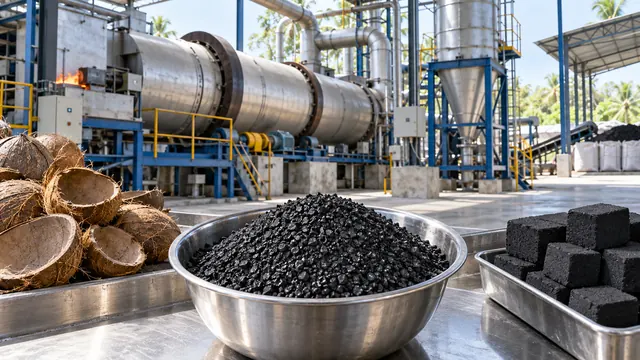
High-temperature steam activation plant producing premium granular and powdered activated carbon (iodine number 900–1,100 mg/g) for water filtration, gold mining, and air purification.
View details →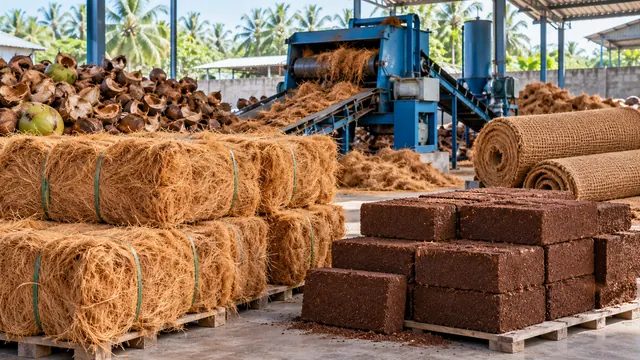
Coconut Coir Fiber Extraction & Compressed Cocopeat Brick Plant
Process raw coconut husks into baled golden coir fiber for industrial upholstery/geotextiles and washed, low-EC compressed cocopeat blocks for global horticulture exports.
View details →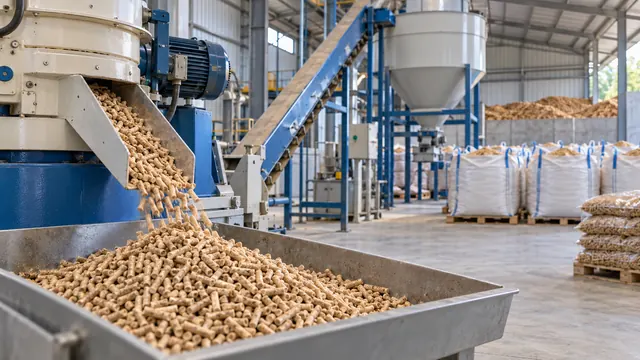
Biomass Wood Pellet & Agricultural Residue Fuel Processing
Produce high-density biomass wood pellets from fast-growing energy timber (Gamal, Calliandra) and dry crop residues to supply co-firing power plants and regional industrial boilers.
View details →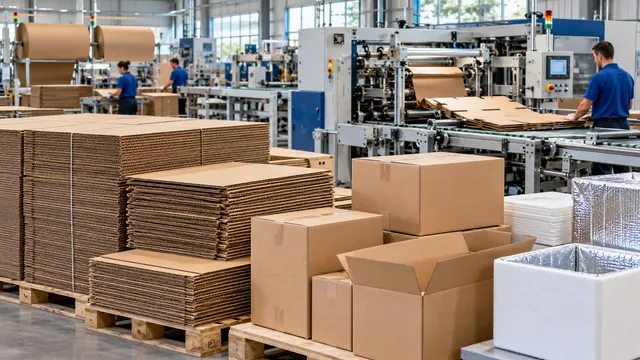
Export Packaging & Corrugated Carton Box Manufacturing
Establish a corrugated carton box, inner partition, and export-grade packaging manufacturing plant inside KIB to supply seafood processors, food manufacturers, and cross-border trade.
View details →